

VOICES, is a forum that highlights the expertise of those who make up and support the organization. WFPG members are invited to submit blog posts on international affairs and foreign policy topics, women's leadership, and career advancement. Posts represent the reflections and personal views of members and not those of their employers or of the WFPG. Interested in submitting a post? Guidelines | Membership
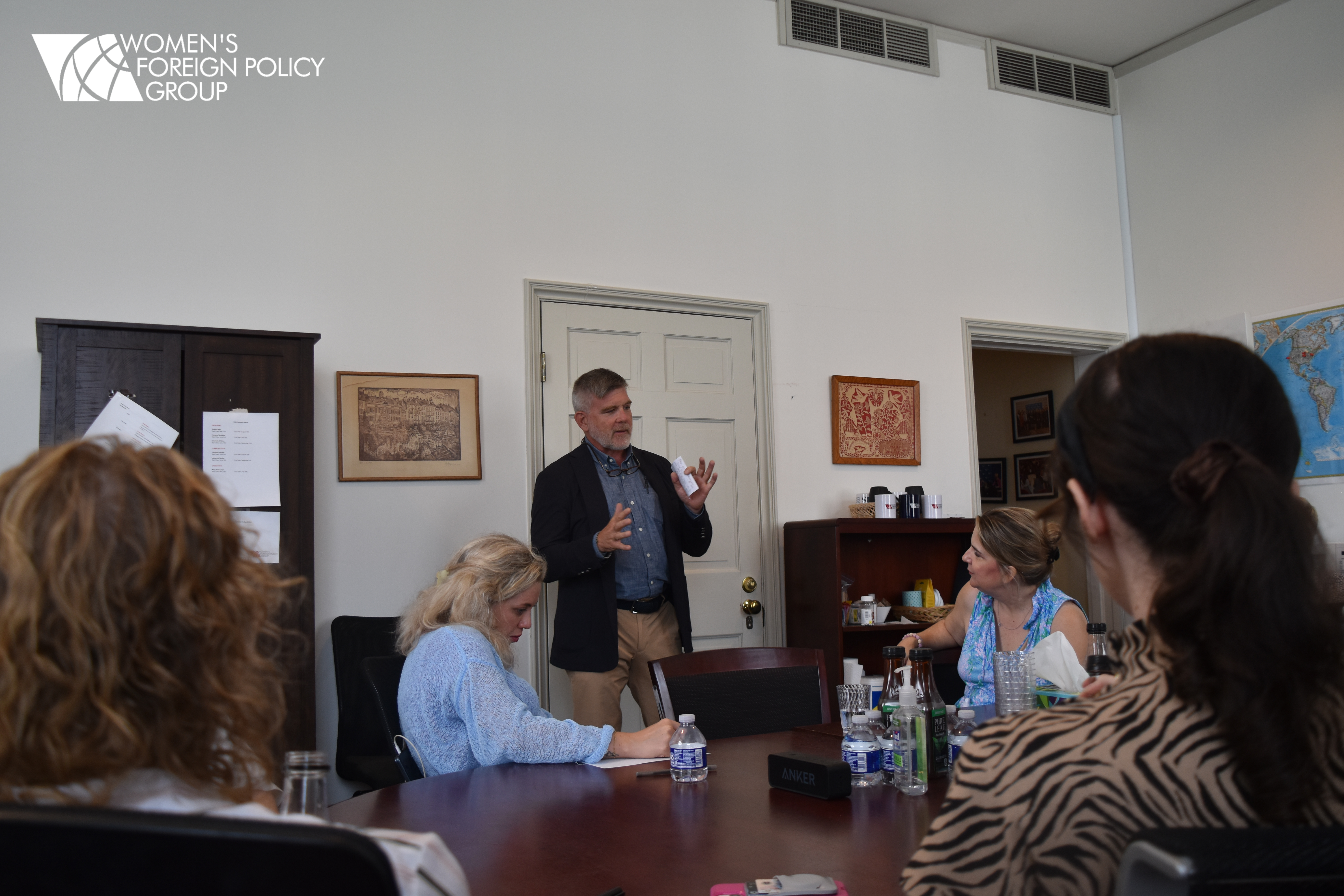
On Thursday, August 13th, the Women’s Foreign Policy Group hosted "Bridging the Gap: Successful Coalition-Building in Youth, Peace, and Security," featuring esteemed panelists Caitlin Dallaire, Senior Nonresident Fellow, New Lines Institute for Strategy and Policy; Founder/Host, The Public Service Project podcast; former Peacekeeping Advisor, U.S. Department of State; and Sarah Sladen, Senior Fellow, Georgetown University Collaborative on Global Children’s Issues; former Youth Coordinator, United States Agency for International Development (USAID). The discussion centered around the advancement of youth voices in foreign policy and peacebuilding since the unanimous adoption of United Nations Security Council Resolution 2250 in 2015. Civil society advocacy laid the groundwork for the Youth, Peace, and Security agenda by challenging dominant narratives of youth in conflict zones as either threats or victims, calling for the UN to engage youth in peacebuilding. The panelists used this framework as a touchstone to discuss the deep nuances of recent Gen Z protests, lessons that recent African institutionalization of the YPS agenda can teach the Global North, and opportunities for building trust and effectively connecting funders to localized community youth-led organizations. Young people as partners, not problems The Youth, Peace, and Security agenda centers around ensuring young people have a voice in their own future and substantive representation in the systems that influence it. In support of this, Sladen cited Freedom House, highlighting that 76% of youth respondents to a UN global survey think politicians don’t listen to young people. Moreover, a staggering 83% of respondents to another survey say that their government has failed to protect their future. Crucially, Dallaire said, young people are entering adulthood while often grappling with new technology, economic realities, educational barriers, and a lack of faith in the integrity of government institutions. As a result, youth across the globe are engaging with social activism differently than past generations, using emerging technology to create increasingly multileader and borderless social movements that create new challenges and opportunities for progress. At the same time, these approaches to activism are built on decades of youth-led activism, calling to mind the U.S. civil rights movement, anti-apartheid movement in South Africa, and Arab Spring in the Middle East and North Africa. However, Sladen argued that increased media exposure often burdens these youth movements with conflictual narratives and language: young leaders and activists are global leaders or changemakers in some narratives, while they are framed as threats or troublemakers in others. In the wake of recent protests in India and Kenya, for example, public discourse can easily distract from the policy demands of a movement, with observers opting to criticize its tactics instead. Today’s digital landscape and social media algorithms are increasingly polarized echo chambers, so it’s crucial for youth activists to understand framing and how digital censorship and social media can shape the intended message of protests or other forms of activism. A possible way for youth-led movements to overcome the increased media visibility and resulting scrutiny is to emphasize the importance of actionable paths forward and center specific policy demands in their public narratives.
The Global South has made significant progress towards the institutionalization of Youth, Peace, and Security initiatives. The African Union pioneered Youth, Peace, and Security with the adoption of the Continental Framework for Youth, Peace and Security in 2019, Africa’s first step towards domesticating the agenda. Subsequently, a number of African nations began to adopt National Action Plans (NAPs) that empower youth in peacebuilding. The first was Nigeria in 2021, followed by seven other states in the past five years, amounting to the highest regional representation of YPS NAPs in the world. However, successful NAP implementation depends on public buy-in, said Sladen, coordination between national and international actors and community-based youth-led organizations. Community-led interventions are highly effective in peace processes and should exist alongside formalized government negotiations to optimize outcomes. As security concerns look different for remote villages and urban centers, financially supporting organizations that uplift youth leadership and creating space for them to have meaningful engagement with peacebuilding processes creates opportunity for what Dallaire called “effective, sustainable, and humane” foreign policy.
Facilitating intergenerational peace processes can evoke necessary discomfort as institutions operate with the assistance of foreign aid. Especially in the Global South, where there are increasingly younger populations and older leaders, Dallaire argued that centering youth voices can remedy the institutional disconnect between the differing lived realities and security concerns of rural and urban communities. Sladen spoke to the difficulties of meaningfully connecting international funders with local organizations from the perspective of a big bureaucratic institution like USAID, where the challenge lies in creating agile funding models with the ability to meet organizations where they are. The panelists were clear: failing to connect young people with donors is a moral, strategic, and tactical mistake. NAPs and international agreements are a start, but fulfilling promises by securing funding for the organizations doing the work on the ground is what supports trust in peacebuilding and policymaking processes. Since the dismantling of USAID, privatized foreign aid is moving to fill the need for funding, and programs centering youth voices continue to be essential to driving meaningful social impact.
Bridging the gap, whether generational, geopolitical, or operational, requires inviting young people into public and institutional peace processes. Dallaire encouraged the audience to think broadly about what peace means for youth and youth-led organizations. Given focus and funding, peacebuilding could look like action for the climate, mobilizing borderless social movements, or supporting hyperlocal community organizations. In an increasingly polarized and conflict-plagued geopolitical landscape, Sladen emphasized that early investment in young people's leadership is crucial, and that engaging across differences is a skillset to be practiced. In our own communities and workplaces, supporting youth empowerment and the YPS agenda means being intentional allies, mentors, and advocates for youth leaders and activists. Grace Treml is a recent graduate of James Madison University, where she completed a B.A. in International Affairs with a concentration in Foreign Policy and Global Governance. She was previously Assistant Program Associate at WFPG.
Tensions and uncertainty for the future of transatlantic relations marked this year’s annual Munich Security Conference. From February 13th to 16th, heads of state, diplomats, politicians, and think tank experts from both sides of the Atlantic gathered for the Conference. As the second Trump Administration has signaled a historic shift away from unwavering European defense cooperation, further shaken by the Greenland crisis, all eyes and ears were on U.S. Secretary of State Marco Rubio. Secretary Rubio offered — in contrast to J.D. Vance’s MSC address last year — a relatively amiable speech. He emphasized the importance of transatlantic cooperation, stating that the United States recognizes a spiritual and cultural connection to Europe. He asked for Europe to join the United States in going beyond diplomatic exercises to stand up for their citizens, referencing American hard power in Venezuela and Iran, saying, “We care deeply about your future and ours.” However, Rubio’s speech was not completely void of a harsh tone. He called for Europe to not rationalize the “broken status quo” of tumultuous transatlantic relations, and stressed that Europe must take more responsibility for their own defense capabilities. This followed recent comments from President Trump suggesting weakness of NATO troops in Afghanistan alongside repeated threats to seize Greenland, a semiautonomous Danish territory. Rubio called for greater action, spending, leadership, and responsibility from the European bloc — blanketed between acknowledgements of a special relationship, setting a tone of tough love. European leaders crafted a similar image of a stronger Europe in their respective speeches. European Commission President Ursula Von Der Leyen called for the bloc to bring its mutual defense cause “to life,” emphasizing internal security over dependence on the United States in the light of Russian aggression and a rocky U.S. commitment to NATO. German Chancellor Friedrich Merz and French President Emmanuel Macron called for greater independence, strength, and a reinvigorated security alliance that benefits both Europe and the United States. In concluding his address, Secretary Rubio assured anxious ears that, “In a time of headlines heralding the end of the transatlantic era, let it be known and clear to all that this is neither our goal nor our wish – because for us Americans, our home may be in the Western Hemisphere, but we will always be a child of Europe.” Representation from the United States at the Munich Security Conference signaled a cooperative future between historic allies, though not without a shifting balance of responsibilities. For the past 80 years, transatlantic allyship has provided mutually-benficial economic, political, and military strength. A departure from these historic ties would almost certainly yield dangerous consequences for North American and European security alike. In Munich, both parties acknowledged the crucial allied relationship at a time where heightened world conflict, division, and fragmentation require multilateral cooperation. Anna Zell is a fourth-year undergraduate at George Washington University pursuing a B.A. in International Affairs and French with a concentration in Comparative Political, Economic, and Social Systems. She was previously a Programs intern at WFPG. BLOG ARCHIVES | 2025| 2024 | 2023 | 2022 | 2021 | 2020 | 2019 |